
The crankshaft main bearing shells are precision made and are replaceable without machining. They consist of an upper bearing shell seated in each cylinder block main bearing support and a lower bearing shell seated in each main bearing cap. See Figure "Main Bearing Caps, Bearing Shells and Crankshaft Thrust Washers" .
|
1. Upper No. 6 Thrust Washers |
8. Main Cap No. 1, 2, 3, 4, 5 & 7 |
|
2. Crankshaft |
9. Lower Thrust Bearing Shell |
|
3. Lower No. 6 Thrust Washers |
10. Woodruff Key |
|
4. Lower No. 6 Thrust Bearing Shell |
11. Upper Thrust Bearing Shell No. 1, 2, 3, 4, 5 & 7 |
|
5. Washer |
12. Cylinder Block |
|
6. Bolt |
13. Upper No. 6 Thrust Bearing Shell |
|
7. No. 6 Main Cap |
|
Figure 1. Main Bearing Caps, Bearing Shells and Crankshaft Thrust Washers
The upper and lower bearing shells are located in the respective block and bearing cap by a tang. The tang is located at the parting line at one end of each bearing shell. The tangs are offset from center to aid correct insertion. Bearing shell sets are supplied as a matched assembly and should not be mixed.
A hole in each upper bearing shell registers with a vertical oil passage in the cylinder block. Lubricating oil, under pressure, passes from the cylinder block oil gallery by way of the bearing shells to the drilled passage in the crankshaft, then to the connecting rods and connecting rod bearings. The upper bearing shell is also grooved.
The lower main bearing shells have no oil holes or grooves. Therefore, the upper and lower main bearing shells must not be interchanged.
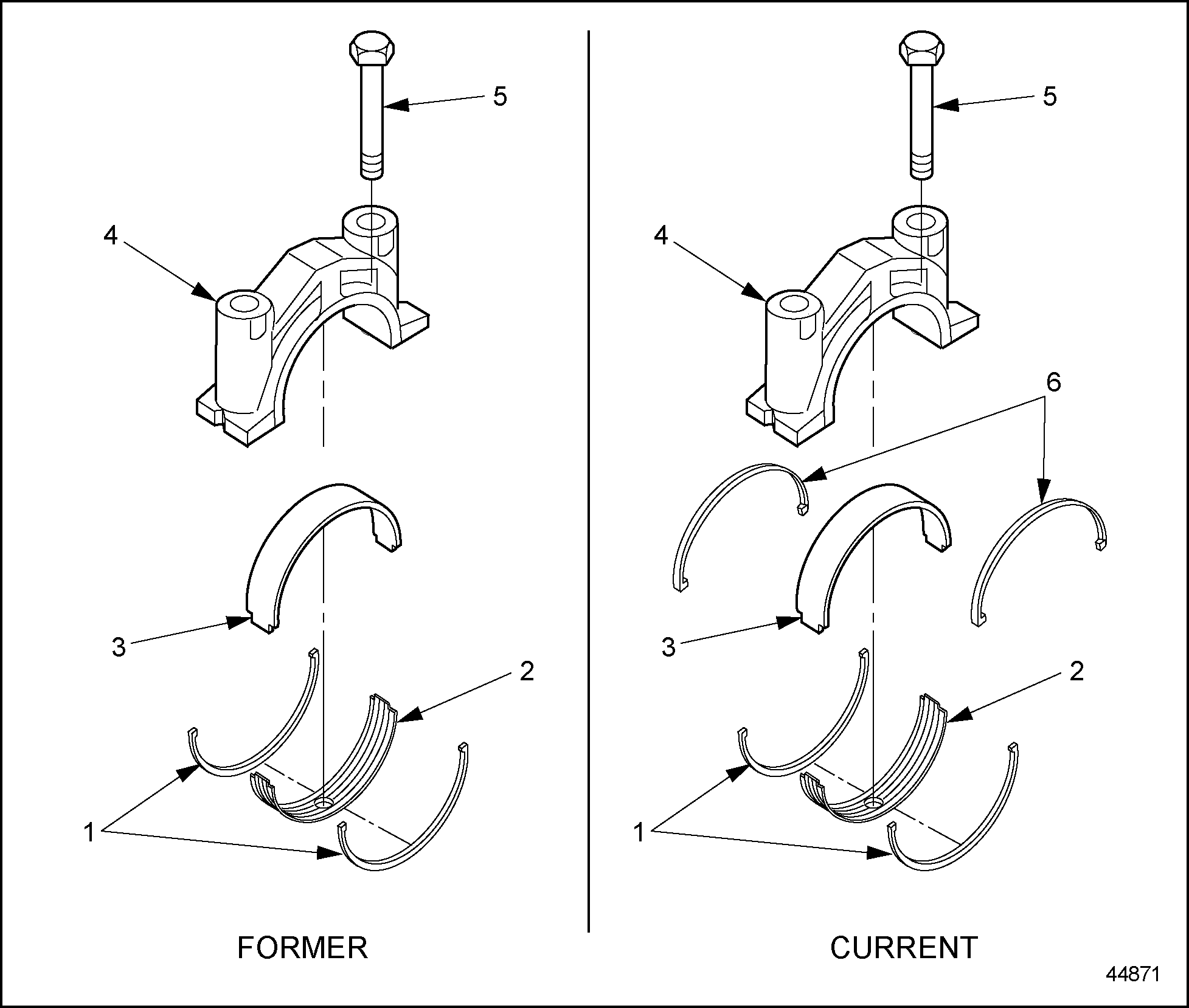
Thrust washers on each side of the No. 6 main bearing absorb the crankshaft thrust. Engines built prior to 06R0762048 use the two-piece washers with locking tangs that register with locating notches in the bearing shell. See Figure "No. 6 Thrust Bearing Detail" .
|
NOTICE: |
|
Do not mix old and new style thrust washers in the same engine. |
Engines built after serial number 06R0762048 will accommodate the current style four-piece thrust washer as well as the former style two thrust washer version. See Figure "No. 6 Thrust Bearing Detail" . The current style thrust washers are marked for front and rear and are designed to directionally rotate into the same upper position with the main bearing cap removed. The No. 6 position main bearings are the same as the other postion.
|
1. Upper Thrust Washer (2) |
4. No. 6 Main Bearing Cap |
|
2. Upper No. 6 Bearing Shell |
5. Bolt |
|
3. Lower No. 6 Bearing Shell |
6. Thrust Washer (2) |
Figure 2. No. 6 Thrust Bearing Detail
The condition of the lower bearing shells may be observed by removing the main bearing caps.
To determine if repair is possible or replacement is necessary, perform the following procedure. See Figure "Flowchart for Repair or Replacement of Crankshaft Main Bearings" .

Figure 3. Flowchart for Repair or Replacement of Crankshaft Main Bearings
The main bearing caps are numbered consecutively, indicating their respective positions. When removed, the bearing caps (and the bearing shells, if they are to be reinstalled) must always be reinstalled in their original position.
Note: If shims are used between the oil pump and the cylinder block, save the shims so that they can be reinstalled in exactly the same location as removed. The shims are used to adjust the crankshaft timing gear-to-oil pump drive gear lash.
Note: Remove and reinstall both upper and lower bearing shells for each main journal being inspected before moving on to the next main journal. Never remove more than one main bearing cap at a time except for No. 6 and No. 7.

Figure 4. Main Bearing Shell Remover and Installer Tool Set
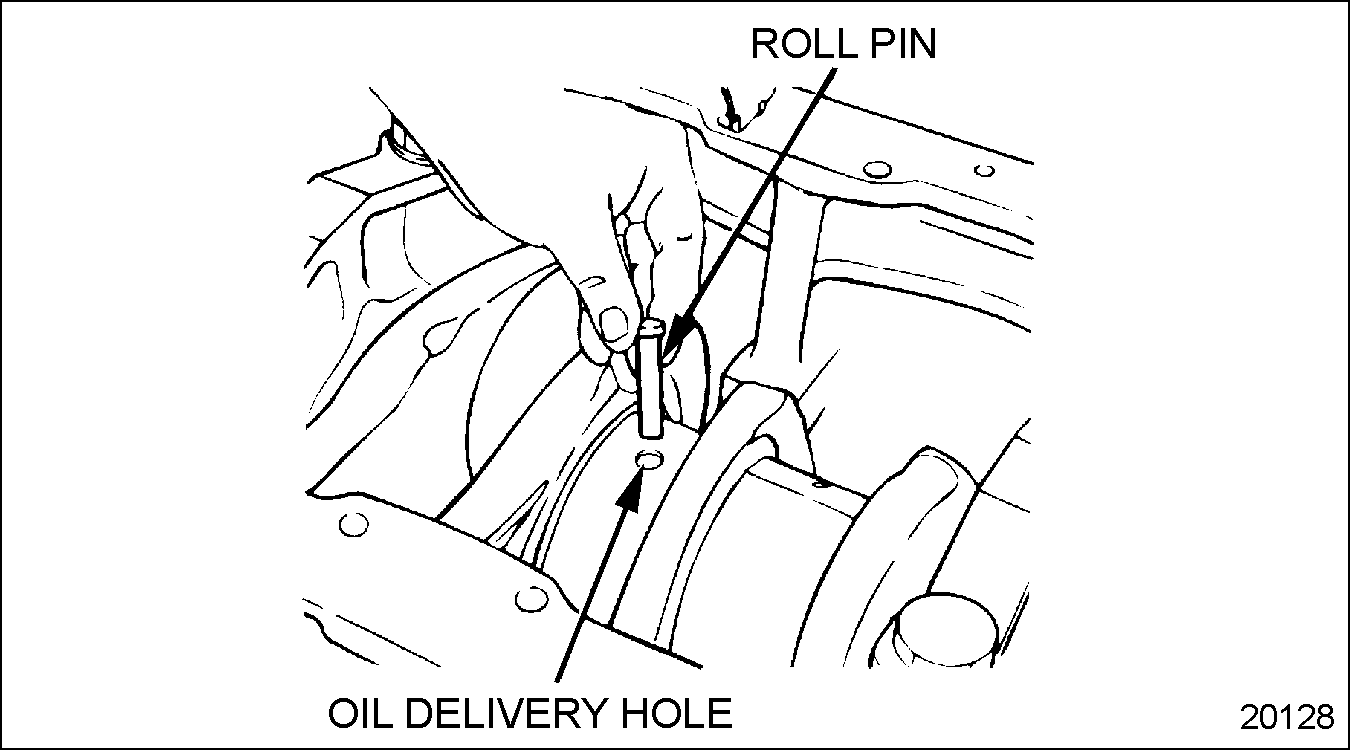
Figure 5. Roll Pin Hole Installation

Figure 6. Upper Main Bearing Shell Removal-Tool Set-Up

Figure 7. Upper Main Bearing Shell Remover Tool Installation
Note: Only the No. 6 main bearing shell requires use of the thrust washers on the sides of the remover tool. For main bearings No. 1, 2, 3, 4, 5, and 7, it will not be necessary to install the thrust washers to the tool.
Note: Keep all bearing shells and thrust washers segregated by number, so that they may be reinstalled exactly as removed if the bearing shells are reused. Shells and washers may be marked with a permanent marker or equivalent. Do not punch mark or otherwise disturb the surface of the shells and washers to mark them.
Note: Thrust washers in the No. 6 main bearing cap are no longer required if the engine was built with them. They do not need to be reinstalled.
Note: No. 7 main bearing journal does not have an oil hole, so the bearing remover cannot be used at that position. The No. 7 upper main bearing should be removed with both No. 6 and No. 7 main bearing caps off. Using a suitable tool, push on the No. 7 upper bearing on the side opposite the tang and dislodge the bearing tang from the tang slot in the cylinder block. Carefully push and pull the bearing the rest of the way out, taking care not to damage the bearing shell. Rotate the crankshaft, and apply some pressure to the side of the bearing while rotating.
Perform the following to clean the main bearing:
 EYE INJURY |
|
To avoid injury from flying debris when using compressed air, wear adequate eye protection (face shield or safety goggles) and do not exceed 276 kPa (40 psi) air pressure. |
Bearing failures may result from deterioration (acid formation) or contamination of the oil or loss of oil. An analysis of the lubricating oil may be required to determine if corrosive acid and sulphur are present, which cause acid etching, flaking and pitting. Bearing seizure may be due to low oil or no oil.
Inspect the bearings for scoring, pitting, flaking, etching; or signs of overheating. The bearing overlay may develop minute cracks or small isolated cavities (checking) on the bearing surface during normal engine operation. These are characteristics of and are not detrimental to this type of bearing. They should not be replaced for these minor surface imperfections, since function of the bearings is in no way impaired and they will give many additional hours of trouble-free operation.
Inspect the backs of the bearing shells for bright spots, which indicate they have been moving in the bearing caps. If such spots are present, discard the bearing shells, and inspect the bearing caps and upper bearing saddles.
Measure the thickness of the bearing shells at a point, 90 degrees from the parting line. See Figure "Main Bearing Measurements" .

Figure 8. Main Bearing Measurements
Attachment tool (J–4757) placed between the bearing shell and a micrometer, will give an accurate measurement. The bearing shell thickness will be the total thickness of the steel ball in the tool and the bearing shell, less the diameter of the ball. This is the only practical method for measuring the bearing thickness, unless a special micrometer is available for this purpose. The minimum thickness of a worn standard main bearing shell is 3.937 mm (0.155 in.). If any of the bearing shells are thinner than this dimension, replace all of the bearing shells. A new standard bearing shell has a thickness of 3.962-3.980 mm (0.1560 -0.1567 in.). If any bearing shell shows wear through the overlay across the width of the shell, all bearing shells must be replaced.
In addition to the thickness measurement, check the clearance between the main bearings and the crankshaft journals. This clearance may be determined with the crankshaft in place by means of a soft plastic measuring strip that is squeezed between the journal and the bearing as described in "Checking Bearing Clearance". Refer to "Additional Information" 1.A. With the crankshaft removed, measure the outside diameter of the crankshaft main bearing journals and the inside diameter of the main bearing shells when installed in place with the proper torque 470-530 N·m (347-391 lb·ft) torque on the bearing cap bolts. When installed, the bearing shells are 0.0254 mm (0.001 in.) larger in diameter at the parting line than 90 degrees from the parting line.
The bearing shells do not form a true circle out of the engine. When installed, the bearing shells have a squeeze fit in the main bearing bore and must be tight when the bearing cap is drawn down. This crush assures a tight, uniform contact between the bearing shell and bearing seat. Bearing shells that do not have sufficient crush will not have uniform contact, as shown by shiny spots on the back, and must be replaced. If the clearance between any crankshaft journal and its bearing shells exceeds 0.1524 mm (0.006 in.), all of the bearing shells must be discarded and replaced. This clearance is 0.040-0.127 mm (0.0016 -0.005 in.) with new parts.
If installing new replacement bearings, it is very important to thoroughly inspect the crankshaft journals. Also, damaged bearings may cause bending fatigue and resultant cracks in the crankshaft. Refer to "1.7.2.11 Crankshaft Cracks" , and refer to "1.7.2.9 Bending Fatigue" .
Do not replace one main bearing shell alone. If one bearing shell requires replacement, install all new upper and lower shells.
Note: Anytime a new or reground crankshaft is used, all new bearing shells must be used.
Bearing shells are available in 0.254, 0.508 and 0.762 mm (approximately 0.010,.020 and 0.030 in.) undersize for service with reground crankshafts as listed in Table "Crankshaft Journal Specifications" to determine what size bearings are required. Ensure the correct bearing to journal clearance is maintained when using these parts.
Note: Bearing shells are NOT reworkable from one undersize to another undersize under any circumstances.
Inspect the crankshaft thrust washers. If the washers are discolored or worn excessively, or if the crankshaft end play is excessive, replace the thrust washers. Inspect the crankshaft thrust surfaces. Refer to "1.7.2.1 Inspection of Crankshaft" . If, after dressing or regrinding the thrust surfaces, new standard size thrust washers do not hold the crankshaft end play within the specified limits, it may be necessary to install oversize thrust washers on one or both sides of the No. 6 main bearing. A new standard size thrust washer is 3.56-3.48 mm (0.140 -0.137 in.) thick. Thrust washers are available in 0.127 and 0.254 mm (0.005 and 0.010 in.) oversize.
Install the main bearing shells as follows:
| Series 60 Service Manual - 6SE483 |
| Generated on 10-13-2008 |