
The crankshaft is a one-piece forging of chrome-alloy steel, heat-treated to ensure strength and durability. See Figure "Crankshaft" .
Note: The natural gas crankshaft has machined counter weights to allow for shorter rods.
Figure 1. Crankshaft
The main and connecting rod bearing journal surfaces and fillets are induction hardened.
Complete static and dynamic balance of the crankshaft has been achieved by counterweights incorporated in the crankshaft.
Current crankshafts may have a six-bolt or twelve-bolt mounting pattern on the front.
NOTICE: |
|
Do not install iron cylinder kits into engines with "lightweight" crankshafts. The piston pin bolts will hit crankshaft counterweights preventing engine from turning over and possibly causing engine damage. |
Note: Effective May 2001, a new “lightweight” crankshaft is used on 12.7L engines using steel pistons. (The iron piston pin bolts interefere with the new lightweight crankshaft design.) See Figure "Current and Former Crankshafts" and see Figure "Varied Piston Dome-Crankshaft Clearances" .
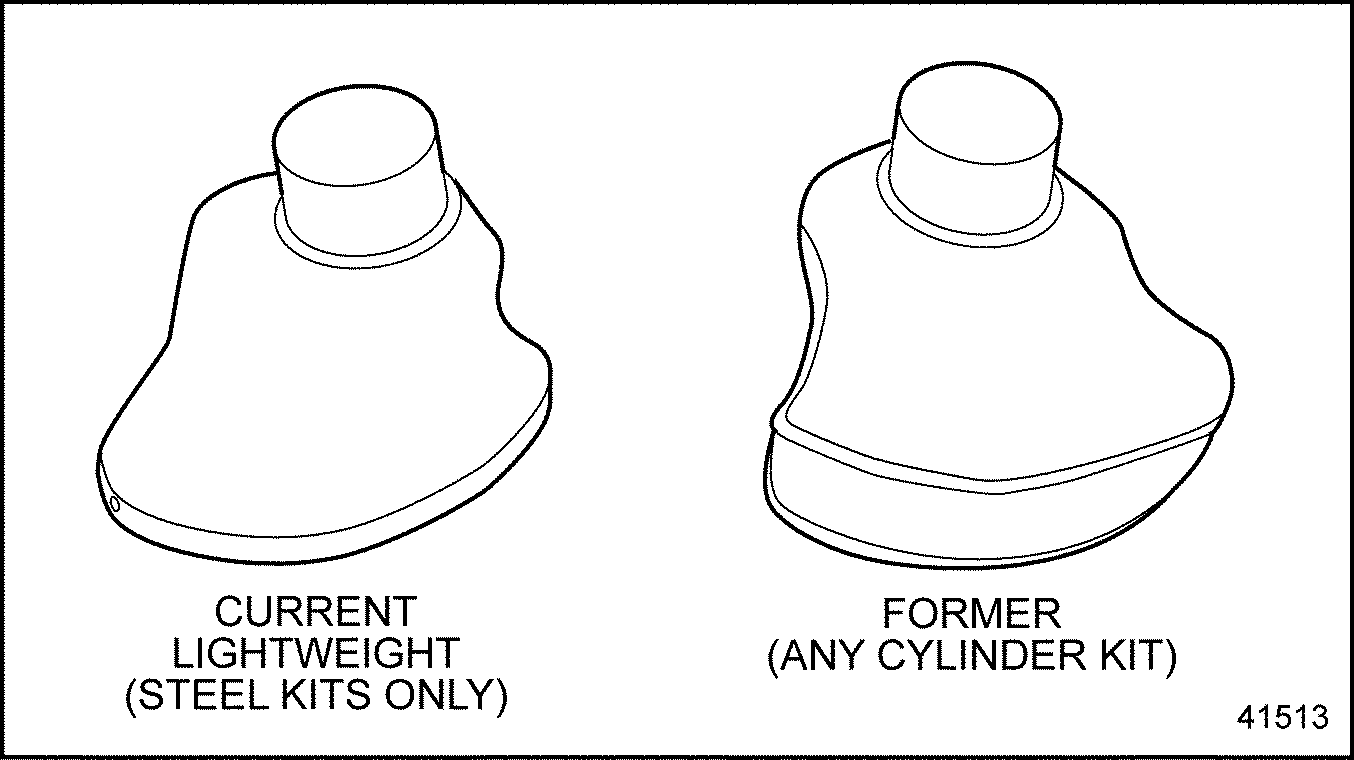
Figure 2. Current and Former Crankshafts

Figure 3. Varied Piston Dome-Crankshaft Clearances
The crankshaft end play is controlled by thrust washers located at the No. 6 main bearing cap and saddle of the engine. See Figure "Crankshaft Thrust Bearing Detail" .

|
1. Upper Thrust Washer (2) |
5. Dowel |
|
2. Upper No. 6 Bearing Shell |
6. No. 6 Main Bearing Cap |
|
3. Lower Bearing Shell (No. 1 through 7) |
7. Main Bearing Cap Bolt |
|
4. Lower Thrust Washer (former design only) |
|
Figure 4. Crankshaft Thrust Bearing Detail
The current design makes use of thrust washers in the upper positions only.
Oversize thrust washers are available to correct for excessive end play.
On some engines, the No. 6 main bearing cap is indexed to the cylinder block by two slots in the cap which register with dowels in the cylinder block. See Figure "Former No. 6 Main Bearing Cap" .
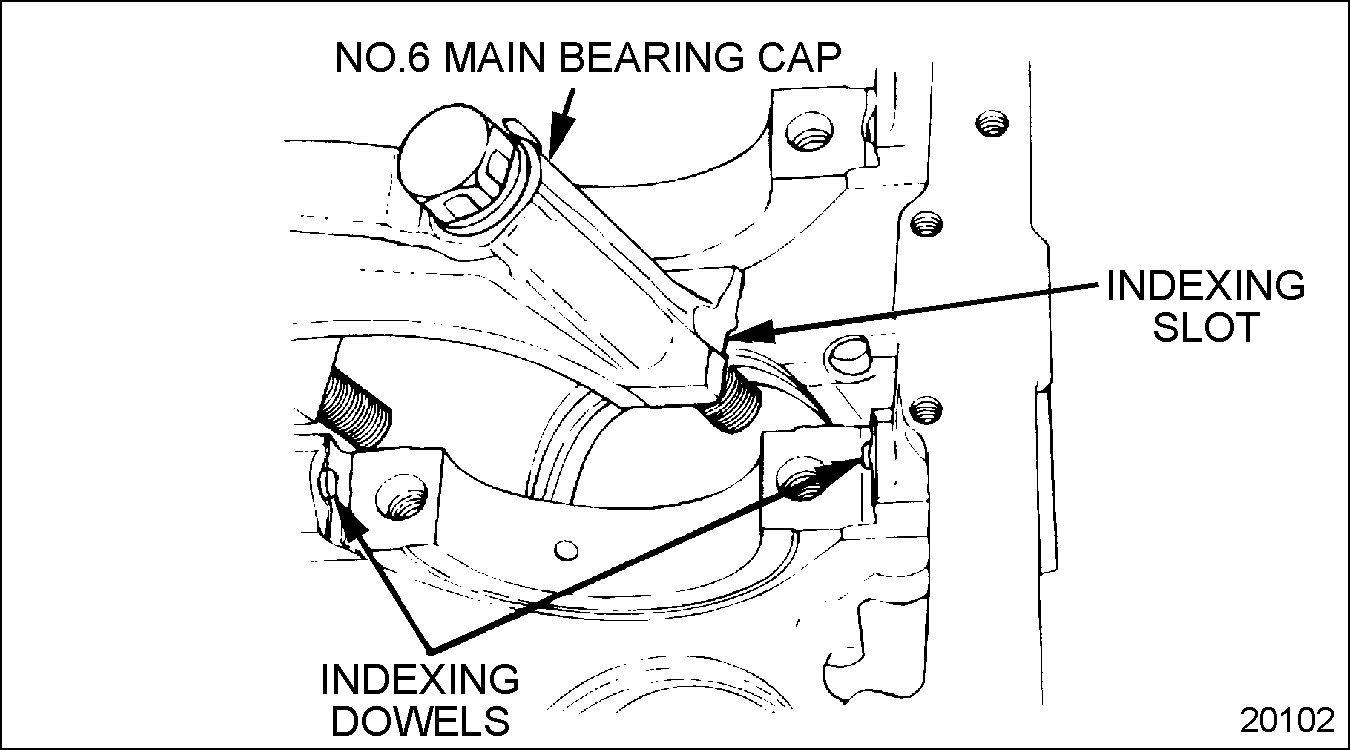
Figure 5. Former No. 6 Main Bearing Cap
The current design does not use the indexing dowels. See Figure "Current No. 6 Main Bearing Cap" .

Figure 6. Current No. 6 Main Bearing Cap
Full pressure lubrication to all connecting rod and main bearings is provided by drilled passages within the crankshaft and cylinder block. See Figure "Crankshaft Lubricating Oil Holes" .
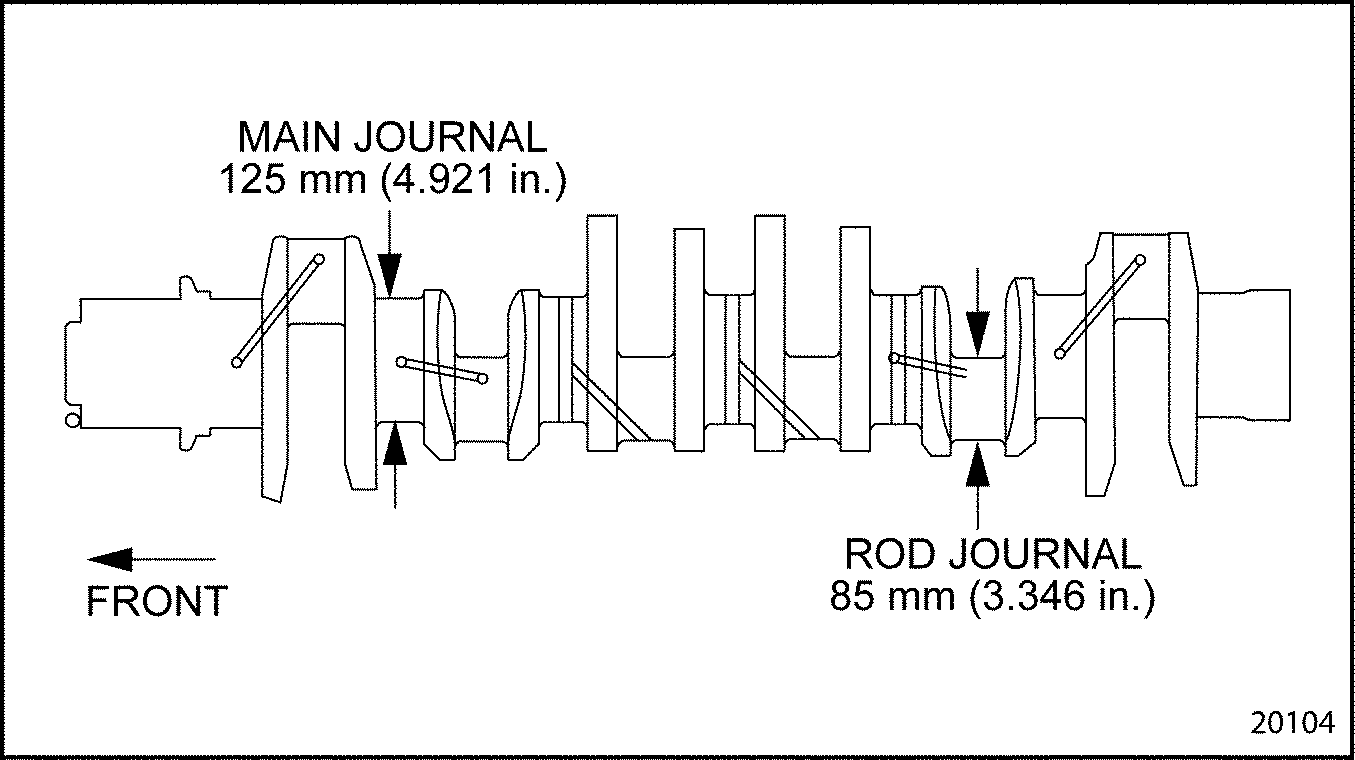
Figure 7. Crankshaft Lubricating Oil Holes
Six or twelve tapped holes, equally spaced, are provided on the rear butt for attaching the flywheel. There are six or twelve equally spaced tapped holes on the front butt of the crankshaft for attaching the crankshaft pulley and vibration damper. No locating dowels are provided at either end.
Each standard main bearing journal is 125.000-124.968 mm (4.921-4.920 in.) in diameter and each standard connecting rod journal is 85.000-84.975 mm (3.346-3.345 in.) in diameter.
New crankshafts with smaller radii fillets (listed in Table "New Crankshafts with Smaller Radii Fillets" ) replaced the former crankshafts, effective with the following engine serial numbers:
|
Engine Model |
Engine Serial Number |
|
6067WK60 (11.1 L) |
6R184522 |
|
6067GK60 (12.7 L) |
6R188251 |
This change was made to permit installation of new, wider connecting rod bearings that increase rod bearing oil film thickness and reduce bearing pressures. The fillets on the new crankshafts have a radius of 4.0-3.5 mm (0.157 -0.138 in.). The fillets on the former crankshafts had a radius of 6.0-5.5 mm (0.236 -0.216 in.). To conform with this change, new connecting rods with smaller rod chamfers were also released. Refer to "1.22 Connecting Rod" for information on the new connecting rods and bearings.
The new crankshafts, bearings, and connecting rods must be used together to ensure interchangeability. Former parts cannot be mixed with new parts in the same engine. The former crankshafts will no longer be available.
To determine if repair is possible or replacement is necessary, perform the following procedure. See Figure "Flowchart for Repair or Replacement of Crankshaft" .

Figure 8. Flowchart for Repair or Replacement of Crankshaft
When removal of the crankshaft becomes necessary, first remove the transmission, then proceed as follows:
 FALLING ENGINE |
|
To avoid injury from a falling engine, ensure the engine is securely attached to the engine overhaul stand before releasing the lifting sling. |
NOTICE: |
|
Use care when removing the crankshaft pulley as the vibration damper may come off. If the damper is allowed to fall, damage to the internal components of the damper may result. |
Note: The connecting rod caps must be reinstalled to their respective connecting rods. The main bearing caps should be kept in sequence, so that they may be installed to their original positions.
Perform the following steps for crankshaft inspection:
|
EYE INJURY |
|
To avoid injury from flying debris when using compressed air, wear adequate eye protection (face shield or safety goggles) and do not exceed 276 kPa (40 psi) air pressure. |
Support the crankshaft on its front and rear journals on V-blocks or the inverted engine block with only the front and rear upper bearing shells in place. Check the intermediate main journals with a dial indicator for run-out when the crankshaft is rotated.
When checking the crankshaft bow, if the run-out is greater than that listed in Table "Crankshaft Bow" , the crankshaft must be replaced.
|
Journals Supported On |
Journals Measured |
Maximum Run-out (Total Indicator Reading) |
|
No. 1 and No. 7 |
No. 2 and No. 6 |
0.076 mm (0.003 in.) |
|
No. 1 and No. 7 |
No. 3 and No. 5 |
0.127 mm (0.005 in.) |
|
No. 1 and No. 7 |
No. 4 |
0.152 mm (0.006 in.) |
When run-out on the adjacent journals is in opposite directions, the sum must not exceed 0.076 mm (0.003 in.) total indicator reading. When the high spots of run-out on the adjacent journals are in the same direction, the difference must not exceed 0.076 mm (0.003 in.) total indicator reading.
Measure all of the main and connecting rod bearing journal diameters. See Figure "Dimensions of Crankshaft Journals" .
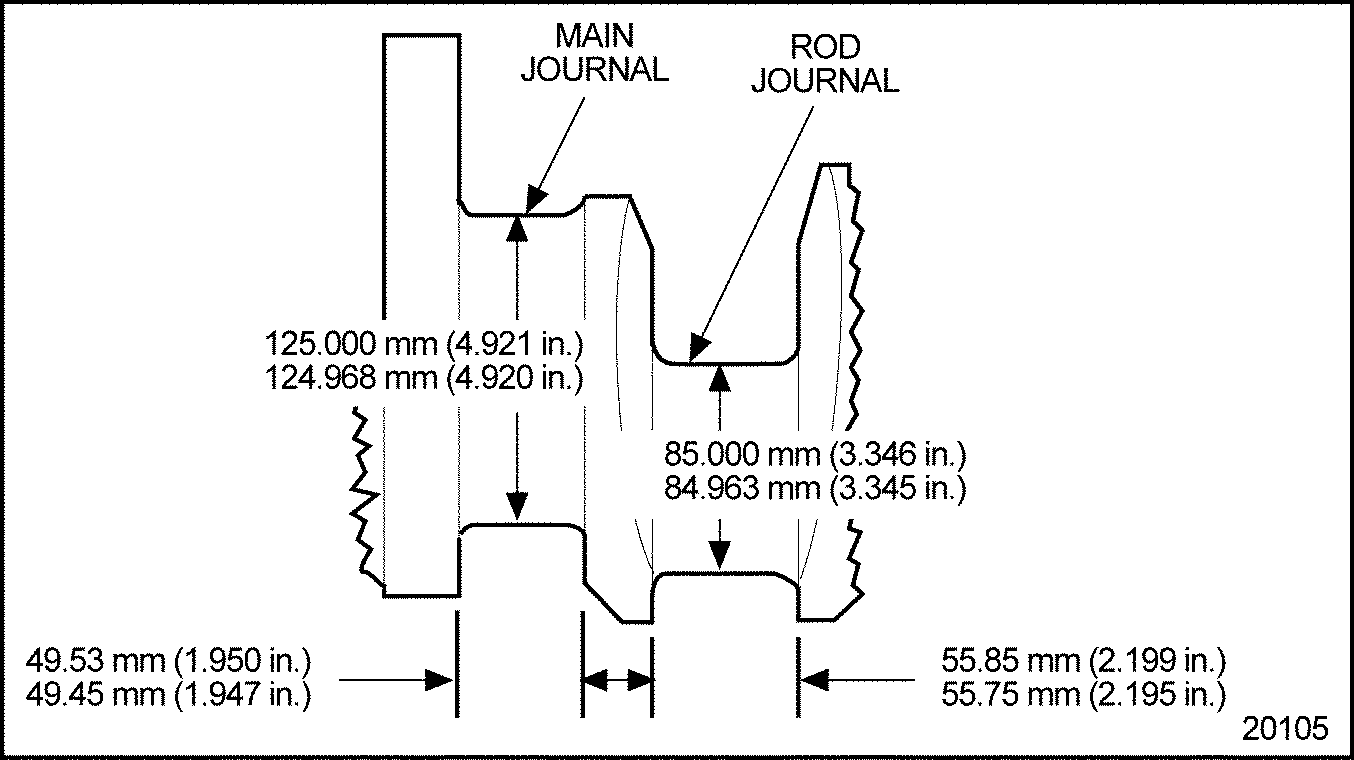
Figure 9. Dimensions of Crankshaft Journals
Measure the journals at several places on the circumference so that taper, out-of-round and bearing clearances can be determined. If the crankshaft is worn so that the maximum connecting rod or main bearing journal-to-bearing shell clearance (with new shells) exceeds 0.1270 mm (0.005 in.) (connecting rod journals) or 0.1422 mm (0.0056 in.) (main bearing journals), the crankshaft must be reground. Measurements of the crankshaft should be accurate to the nearest 0.0025 mm (0.0001 in.). Also, if the main bearing journal taper of a used crankshaft exceeds 0.0381 mm (0.0015 in.) or the out-of-round is greater than 0.0254 mm (0.001 in.) the crankshaft must be reground. Specifications for the crankshaft are listed in Table "Crankshaft" .
Also, measure the distance between crankshaft thrust washer surfaces. See Figure "Dimensions for No. 6 Main Bearing Journal Thrust Width" .

Figure 10. Dimensions for No. 6 Main Bearing Journal Thrust Width
Carefully check the crankshaft for cracks which start at an oil hole and follow the journal surface at an angle of 45 degrees to the axis. Any crankshaft with such cracks must be replaced. Several methods of determining the presence of minute cracks not visible to the eye are available: refer to "1.7.2.6 Magnetic Particle Method" , for magnetic particle method, refer to "1.7.2.7 Fluorescent Magnetic Particle Method" , for fluorescent magnetic particle method, or refer to "1.7.2.8 Fluorescent Penetrant Method" , for fluorescent penetrant method.
Magnetize the crankshaft and then cover it with a fine magnetic powder or solution. The crankshaft must be demagnetized after the test to avoid engine damage.
NOTICE: |
|
Very fine cracks may be missed using the magnetic particle method, especially on discolored or dark surfaces. They will be disclosed under the black light. If the crankshaft is discolored or has dark surfaces, the magnetic particle method should not be used. Refer to "1.7.2.7 Fluorescent Magnetic Particle Method" for suitable alternate method. |
Flaws, such as cracks, form a small local magnet which causes the magnetic particles in the powder or solution to gather there, effectively marking the crack.
This method is similar to the magnetic particle method, but is more sensitive since it employs magnetic particles which are fluorescent and glow under black light. Refer to "1.7.2.6 Magnetic Particle Method" .
This is a method which may be used on both non-magnetic and magnetic materials. A highly fluorescent liquid penetrant is applied to the part. Then the excess penetrant is removed from the surface and the part is dried. A developing powder is then applied which helps to draw the penetrant out of the flaws by capillary action. Inspection is carried out under a black light.
A majority of indications revealed by the above inspection methods are normal and harmless and only in a small percentage of cases is reliability of the part impaired when indications are found. Since inspection reveals the harmless indications with the same intensity as the harmful ones, detection of the indications is but a first step in the procedure. Interpretation of the indications is the most important step.
All crankshafts are magnetic particle inspected after manufacture to ensure against any shafts with harmful indications getting into the original equipment or factory parts stock.
Crankshaft failures are rare and when one cracks or breaks completely, it is very important to make a thorough inspection for contributory factors. Unless abnormal conditions are discovered and corrected, there will be a repetition of the failure.
There are two types of loads imposed on a crankshaft in service: a bending force and a twisting force. The design of the shaft is such that these forces produce practically no stress over most of the surface. Certain small areas, designated as critical areas, sustain most of the load. See Figure "Critical Crankshaft Loading Zones" .
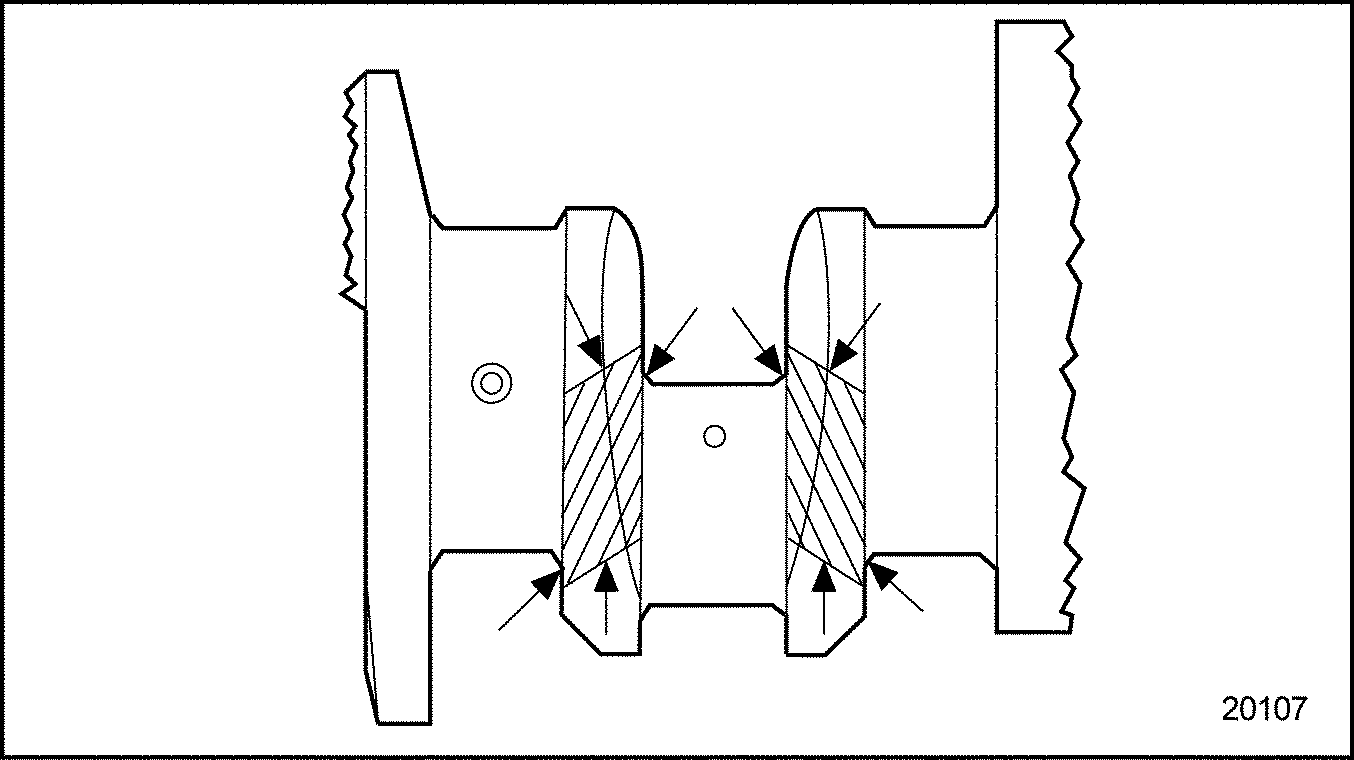
Figure 11. Critical Crankshaft Loading Zones
Failures can result from bending of the crankshaft.
The crankshaft is supported between each of the cylinders by a main bearing and the load imposed by the gas pressure on top of the piston is divided between the adjacent bearings. An abnormal bending stress in the crankshaft, particularly in the crank fillet, may be a result of misalignment of the main bearing bores, improperly fitted bearings, bearing failures, a loose or broken bearing cap, or unbalanced pulleys. Also, drive belts which are too tight will impose a bending load upon the crankshaft.
Failures resulting from bending start at the pin fillet and progress throughout the crank cheek, sometimes extending into the main journal fillet. If main bearings are replaced due to one or more badly damaged bearings, a careful inspection must be made to determine if any cracks have started in the crankshaft. These cracks are most likely to occur on either side of the damaged bearing.
Failures result from torsional vibration which takes place at high frequency. A combination of abnormal speed and load conditions may cause the twisting forces to set up a vibration, referred to as torsional vibration, which imposes high stresses at the locations. See Figure "Crankshaft Fatigue Cracks" .

Figure 12. Crankshaft Fatigue Cracks
Torsional stresses may produce a fracture in either the connecting rod journal or the crank cheek in the rear. Torsional failures may also occur at the front end of the crankshaft at the crankshaft timing gear drive key slot. Connecting rod journal failures are usually at the fillet or oil hole at 45 degrees to the axis of the shaft.
A loose, damaged or defective vibration damper, a loose flywheel or the introduction of improper or additional pulleys or couplings are usual causes of this type of failure. Also, overspeeding of the engine or overriding the engine electronic control system to allow engine overspeeding may be contributory factors.
As previously mentioned, most of the indications found during inspection of the crankshaft are harmless. The two types of indications to look for are circumferential fillet cracks at the critical areas and 45° cracks (45° to the axis of the shaft) starting from either the critical fillet locations or the connecting rod journal holes. See Figure "Crankshaft Fatigue Cracks" . Replace the crankshaft when cracks of this nature are found. Refer to "1.7.3 Installation of Crankshaft" .
The use of properly remanufactured crankshafts is very important to maximize crankshaft main and connecting rod bearing life.
Remanufactured crankshafts must conform to specifications. See Figure "Crankshaft Fatigue Cracks" . The dimensional requirements for journal axial profile, radial chatter and oil hole washout require confirmation with a Gould 1200 Surface Analyzer (or equivalent). Information on Gould 1200 is available in the "Glossary". Refer to "Additional Information" 1.A.
Note: Visual inspection cannot be relied upon to confirm the compliance to journal quality specifications.
The procedure of crankshaft journal polishing can easily create axial profile and oil hole washout conditions beyond specifications. Any polishing operation should be followed by Gould 1200 (or equivalent) measurements to assure conformance to remanufactured specifications. Refer to "Additional Information" 1.A, "Crankshaft Remanufacturing Procedures".
All used crankshafts that have not been reground must meet the dimensional specifications standard or be reground to specifications. Refer to "Additional Information" 1.A, "Crankshaft Remanufacturing Procedures".
In addition to standard size crankshaft thrust washers, 0.127 mm (0.005 in.) and 0.254 mm (0.010 in.) oversize thrust washers are available. Thrust surface specifications are listed in Table "Crankshaft" .
Remanufactured crankshafts should be stamped on the edge of the No. 1 crank throw (counterweight) with the appropriate undersize dimensions for identification purposes.
Note: Crankshaft main bearing journals and/or connecting rod journals which exhibit discoloration due to excessive overheating from bearing failure are NOT acceptable for rework.
If one or more main or connecting rod journals require grinding, grind all of the main journals or all of the connecting rod journals to the same required size.
Install the crankshaft using the following procedure:
|
EYE INJURY |
|
To avoid injury from flying debris when using compressed air, wear adequate eye protection (face shield or safety goggles) and do not exceed 276 kPa (40 psi) air pressure. |
Note: When a new or reground crankshaft is installed, ALL new main and connecting rod (upper and lower) bearing shells and new thrust washers must also be installed.
Note: If the crankshaft surfaces were reground, it may be necessary to install oversize thrust washers on one or both sides of the No. 6 main journal. See Figure "Crankshaft Thrust Bearing Detail" .
Note: If timing gear and timing wheel were removed install timing gear and timing wheel prior to installation of crankshaft.Refer to "1.34.3 Installation of Crankshaft Timing Gear and Timing Wheel" .
Note: It may be easier to remove the bull gear assembly and re-time the engine.
Note: Whether the engines were built with or without thrust washers in the No. 6 main bearing cap, they are no longer required; they do not need to be reinstalled.
Note: The main bearing caps are bored in position and stamped with position number. They must be installed in their original positions, with the marked (numbered) side of each cap toward the cooler (right) side of the cylinder block.

Figure 13. Main Bearing Cap Installation
Note: If the bearings have been installed properly, the crankshaft will turn freely with all of the main bearing cap bolts drawn to the specified torque.

Figure 14. Measuring Crankshaft End Play
| Series 60 Service Manual - 6SE483 |
| Generated on 10-13-2008 |