The cylinder block is the basic engine structure, establishing and maintaining the alignment of all engine working parts. In the Series 60 Engine, the cylinder bores are not an integral part of the block casting, but are in the form of replaceable, wet type cylinder liners. See Figure
"Series 60 Cylinder Block and Liner"
.
Flanges at the liner upper ends seat in counterbores in the block deck, and project slightly above the deck to compress the head gasket for a good compression seal. Below the water jacket the lower end of the cylinder liner has two D-shaped seal rings and a lipped crevice seal to prevent leakage between the water jacket and crankcase.
1. Cylinder Block
4. Cylinder Liner
2. D-rings
5. Integral Coolant Inlet Manifold
3. Crevice Seal
6. Oil Galleries
Figure 1. Series 60 Cylinder Block and Liner
An integral coolant inlet manifold is cored into the right side of the block. It distributes the water pump output along the length of the block. Oil galleries are machined into the cooler side of the block. See Figure
"Series 60 Cylinder Block and Liner"
.
The integral oil galleries direct the oil pump output through the external oil cooler and filters, to the main oil gallery and to drilled passages in the crankcase webs which supply oil under pressure to each main bearing. In the crankcase, five integral webs plus front and rear bulkheads support the crankshaft in seven main bearings. See Figure
"Series 60 Cylinder Block Crankcase"
.
Figure 2. Series 60 Cylinder Block Crankcase
An improved cylinder block has replaced the former block on all Series 60 engines. This change took effect with unit serial number 6R210293, built November 30, 1994. The former cylinder block was used on engines built prior to this serial number.
The Series 60 cylinder block was further improved by the addition of a drilled lubrication orifice and bolt hole at the base of each cylinder bore. See Figure
"Series 60 Cylinder Block Crankcase"
. The orifices are drilled into the main oil gallery and are required for installation of bolt-on oil spray nozzles used with forged steel pistons on premium engines. When blocks are used for non-premium engines with cast-iron pistons, the lubrication orifices are closed with bolt-on steel plates. First usage of the drilled block was on May 2, 1998, effective with engine serial number 6R408505.
The improved block permits installation of adaptorless Bendix and Midland air compressors onto the gear case. The improved block is similar to the former block, except that it has a slightly modified sidewall configuration that eliminates interference between the block and the adaptorless compressor. To compensate for the elimination of the adaptor, air compressor mounting bracket bolt holes have been moved forward 130.3 mm (5.13 in.) on the block. See Figure
"Cylinder Block Showing Current Modifications"
. Since these holes have a different spacing than the former holes, an improved compressor mounting bracket is required. A new air compressor coolant supply port has also been added forward of the former supply port. The former port is plugged when the adaptorless compressor is installed.
Figure 3. Cylinder Block Showing Current Modifications
When replacing a former block with an improved block, it is recommended (but not necessary) that an adaptorless air compressor, improved compressor mounting bracket, and improved compressor coolant supply hose be installed. Refer to "11.1.3 Installation of Adaptorless Air Compressor"
, of this manual for information on installing the adaptorless air compressor.
Section 1.1.1 Repair or Replacement of Cylinder Block
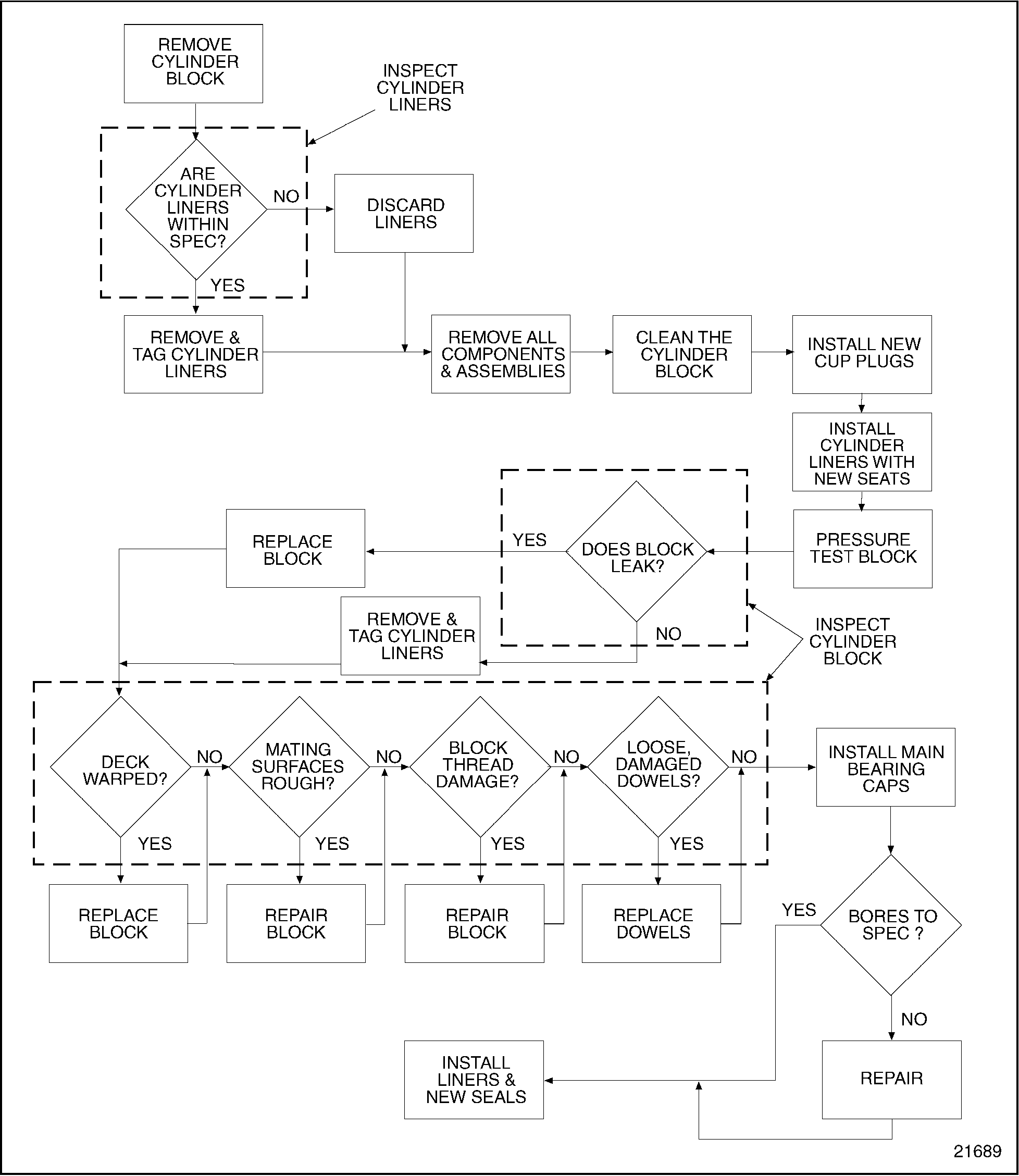
Figure 4. Flowchart for Repair or Replacement of Cylinder Block
Section 1.1.2 Removal and Disassembly of Engine from the Vehicle
Before mounting an engine on an overhaul stand, it must be disconnected from the transmission. Details for removing an engine will vary from one application to another. However, the following steps will be necessary, regardless of application:
Disconnect the battery cable(s) from the battery(s).
Drain the cooling system completely by removing the drain plug in the oil cooler and opening the drain cocks in the cylinder block, thermostat housing and water pump housing. Refer to "14.6.4 Cooling System"
.
Disconnect the inlet fuel line from the primary fuel filter and the outlet line from the upper fitting at the rear of the cylinder head. Refer to "2.10.1 Replacement of Fuel Filter"
.
Remove the air cleaner ducting as necessary for engine removal. Refer to OEM guidelines.
Connect a suitable lifting device to the engine using all three lifting brackets (two at the rear and one at the front).
Separate the engine from the transmission .
Remove the engine mounting bolts.
FALLING ENGINE
To avoid injury from a falling engine, an adequate lifting device with a spreader bar and sling should be used to lift the engine. The sling and spreader bar should be adjusted so the lifting hooks are vertical to prevent bending the lifter brackets. To ensure proper weight distribution, all provided lifter brackets must be used.
Note: DDC has discontinued the use of the ECM cold plate on all Series 60 automotive engine models, effective with unit serial number 06R0008950. In place of the ECM cold plate, a No. 6 x 37.92 in. (963 mm) long hose assembly (23504785) is now routed from the fuel pump discharge fitting to the inlet of the secondary fuel filter.
Disconnect the harness connector (gray) from the timing reference sensor (TRS) at the lower left corner of the gear case. Remove the TRS from the gear case. Refer to "2.32.2 Removal of Timing Reference Sensor"
.
Before removing main bearing caps, be sure each is stamped or punch-marked in numerical order, beginning with No. 1 at the front, to ensure installation in their original position. Mark all caps on the oil cooler side (right side) of the engine to prevent reversal at assembly. Failure to mark numerical order may result in the caps being put back in incorrect order, improper crankshaft support and severe crankshaft or bearing damage or both.
Remove cylinder liners with the cylinder liner removal tool (J–45876)
before putting the block in cleaning or descaling baths, to avoid trapping cleaning agents in block liner seating bores. See Figure
"Cylinder Liner Removal Tool (J-45876)"
.
Figure 9. Cylinder Block Test Deck Plate Installation
Clean the cylinder block as follows:
Remove all oil and water gallery and weep hole plugs to allow the cleaning solution to enter the inside of the oil and water passages. On current block, remove bolt-on plate or piston-cooling oil spray nozzle at the base of each cylinder bore.
Immerse and agitate the block in a hot bath of a commercial, heavy-duty alkaline solution.
Wash the block in hot water or steam clean it to remove the alkaline solution.
If the water jackets are heavily scaled, proceed as follows:
Immerse and agitate the block in a bath of inhibited phosphoric acid.
Allow the block to remain in the acid bath until the bubbling action stops (approximately 30 minutes).
Lift the block, drain it and immerse it again in the same acid solution for 10 more minutes. Repeat until all scale is removed from the water jacket area.
Rinse the block in clear, hot water to remove the acid solution.
Neutralize the acid that may cling to the casting by immersing the block in an alkaline bath.
Wash the block in clean water or steam clean it.
EYE INJURY
To avoid injury from flying debris when using compressed air, wear adequate eye protection (face shield or safety goggles) and do not exceed 276 kPa (40 psi) air pressure.
Dry the cylinder block with compressed air. Blow out all of the bolt holes and passages with compressed air.
Note: The above cleaning procedure may be used on all ordinary cast iron and steel parts for the engine. Aluminum parts, such as flywheel housing, air intake manifold, oil filter adaptor and the camshaft gear access cover should NOT be cleaned in this manner. Mention will be made of special procedures when necessary.
Be certain that all water passages and oil galleries have been thoroughly cleaned and dried. Install weep hole plugs and precoated pipe plugs. Install new cup plugs using a coating of good grade non-hardening sealant such as Loctite® 620 or equivalent. Refer to "Additional Information"
1.A, "Engine Plug and Dowel Chart."
Pressure test the cylinder block. Two methods of cylinder block pressure testing may be used depending on the test facilities available:
Install the bolts through the strips and into the cylinder block. Torque the bolts on the ring strips to 230-237 N·m (170-175 lb·ft). Torque the bolts on the outside strips to 14 N·m (10 lb·ft).
Note: At the base of each liner, the space between upper and lower liner seals is vented to the block surface on the left side. Any coolant leakage past the upper seal is drained to the outside rather than into the crankcase, and is easily detected by a visual inspection.
With a suitable lifting device and spreadable bars, immerse the cylinder block for twenty minutes in a tank of water heated to 82-93°C (180-200°F).
Attach an air line to the water inlet cover plate and apply 138 kPa (20 psi) air pressure to the water jacket. Observe the water in the tank for bubbles that will indicate cracks or leaks. A cracked cylinder block must be replaced by a new block.
EYE INJURY
To avoid injury from flying debris when using compressed air, wear adequate eye protection (face shield or safety goggles) and do not exceed 276 kPa (40 psi) air pressure.
Remove the block from the water tank. Remove the plates and gaskets and blow out all of the passages in the block with compressed air.
Section 1.1.3.2 Testing the Cylinder Block (Leak-Marker Pressure)
When a large water tank is not available, or when it is desired to check the block for cracks without removing the engine from the vehicle cylinder block, leak-marker pressure testing may be used. However, it is necessary to remove the cylinder head, oil cooler, and oil pan.
Fill the water jacket with a mixture of water and 3.8 liters (1 U.S. gallon) of permanent-type antifreeze. The antifreeze will penetrate small cracks and its color will aid in detecting their presence.
Install the bolts through the strips and into the cylinder block. Torque the bolts on the ring strips to 230-237 N·m (170-175 lb·ft). Torque the bolts on the outside strips to 14 N·m (10 lb·ft).
Note: At the base of each liner, the space between upper and lower liner seals is vented to the block surface, on the left side. Any coolant leakage past the upper seal is drained to the outside rather than into the crankcase, and is easily detected by a visual inspection.
Apply 138 kPa (20 psi) air pressure to the water jacket and maintain this pressure for at least two hours to give the water and antifreeze mixture ample time to work its way through any cracks which may exist.
At the end of this test period, examine the outside diameter area of the liner flanges, oil passages, crankcase and exterior of the block for presence of the water and antifreeze mixture, which will indicate the presence of cracks. A cracked cylinder block must be replaced with a new block.
EYE INJURY
To avoid injury from flying debris when using compressed air, wear adequate eye protection (face shield or safety goggles) and do not exceed 276 kPa (40 psi) air pressure.
After the pressure test is completed, remove the test deck plate and gasket and the water inlet cover plate. Drain the water jacket. Then blow out all of the passages in the cylinder block with compressed air.
Check front-to-rear flatness next to the cylinder liner flanges on both sides, and side-to-side flatness between the liner flanges. The deck must be flat within 0.127 mm (0.005 in.) front-to-rear, and flat within 0.0762 mm (0.003 in.) side-to-side. If not, the deck must be resurfaced.
NOTICE:
The camshaft is mounted in the cylinder head so resurfacing of the block affects the position of the camshaft in relation to the adjustable idler gear and gear train.
Figure 15. Recording Stock Removal on Cylinder Block Pad
Section 1.1.3.5 Inspection of Main Bearing Bores
Perform the following steps for main bearing bore inspection:
Install the main bearing caps in their original positions. Lubricate the cap bolt threads and head contact surfaces with a small quantity of International Compound #2®.
International Compound #2® is a registered trademark of IRMCO.
Install the main cap bolts and torque to 470-530 N·m (347-391 lb·ft).
Measure the main bearing bores using dial bore gage which has a dial indicator calibrated in 0.0001 in. increments. Set the cylinder bore gage on zero in master setting fixture. See Figure
"Gaging Main Bearing Bores"
.
Figure 16. Gaging Main Bearing Bores
The bore diameter specifications is 133.00-133.025 mm (5.236-5.237 in.). Line boring is also necessary when a bearing cap must be replaced due to breakage or spun-bearing damage. Refer to "Additional Information"
1.A, for line bore specifications which are listed in Table
"Cylinder Block"
.
Note: Dial bore master setting fixture should be used to zero the cylinder bore gage.
Section 1.1.3.6 General Inspection
Check all machined surfaces for nicks or burrs that could affect the fit of mating parts. Clean up as necessary by stoning. Also inspect all tapped holes for thread damage and retap or install helical thread inserts as necessary. Replace any loose or damaged dowel pins. Refer to "Additional Information"
1.A, "Engine Plug and Dowel Charts" for specifications.
Section 1.1.3.7 Rust Prevention
After inspection, if the cylinder block is not to be used immediately, spray the machined surfaces with engine oil.
NOTICE:
Castings free of grease or oil will rust when exposed to the atmosphere. Rust on machined surfaces may result in leakage.
If the block is to be stored for an extended period of time, spray or dip it in a polar-type rust preventive such as "Tectyl® 502-C" from Valvoline Oil Company (or equivalent).
Tectyl® is a registered trademark of Ashland Oil, Inc.
Section 1.1.4 Reassembly of Cylinder Block
After the cylinder block has been cleaned and inspected, assemble the engine as follows:
EYE INJURY
To avoid injury from flying debris when using compressed air, wear adequate eye protection (face shield or safety goggles) and do not exceed 276 kPa (40 psi) air pressure.
Before a reconditioned or new service replacement cylinder block is used, steam clean it to remove the rust preventive and blow out the oil galleries with compressed air.
Figure 17. Location of Engine Serial and Model Numbers
Also stamp the position numbers on the main bearing caps and the position of the No. 1 bearing on the cooler side of the oil pan mounting flange of the block.
Always check to make sure cooling nozzles are open and aligned after piston installation. An obstructed, misaligned, bent, or damaged nozzle may not provide proper piston cooling. A loosened nozzle may cause a loss of main gallery oil pressure. In either case, piston overheating or lack of adequate lubrication may result in severe engine damage.
On current non-premium engines with cast iron pistons, install the bolt-on plate over the oil gallery orifice at the base of each cylinder bore. On premium engines with closed-end rods and forged steel pistons, install oil spray nozzles into these openings. See Figure
"Oil Spray Nozzle Location"
for location of nozzle. Torque plate nozzle retaining bolts to 30–38 N·m (22–28 lb·ft).
Figure 18. Oil Spray Nozzle Location
Install all of the required cup plugs. Use a good grade of non-hardening sealant such as Loctite® 620 (or equivalent). Apply a thin coat of sealant just inside the chamfer where the plug is to be installed and install using cup plug installation tool set (J–35653)
. See Figure
"Cup Plug Installation Tool Set"
.
Note: Whenever a pipe plug is removed from the cylinder block, the threads must be coated with Loctite®, PT-7260
, pipe sealant with Teflon, or equivalent, before reassembly. Certain plugs available from the parts depot already have a sealer applied to the threads. Although unnecessary, this pre-coating will not be affected if pipe sealer with Teflon is also applied.
With the engine mounted on the overhaul stand, install all of any remaining subassemblies and parts on the cylinder block.
Transfer the engine to a suitable engine dynamometer test stand. Operate the engine on a dynamometer following the Run-in procedure; refer to "12.7.3.2 Run-in Procedure"
.
Install the engine in the equipment from which it was removed.